
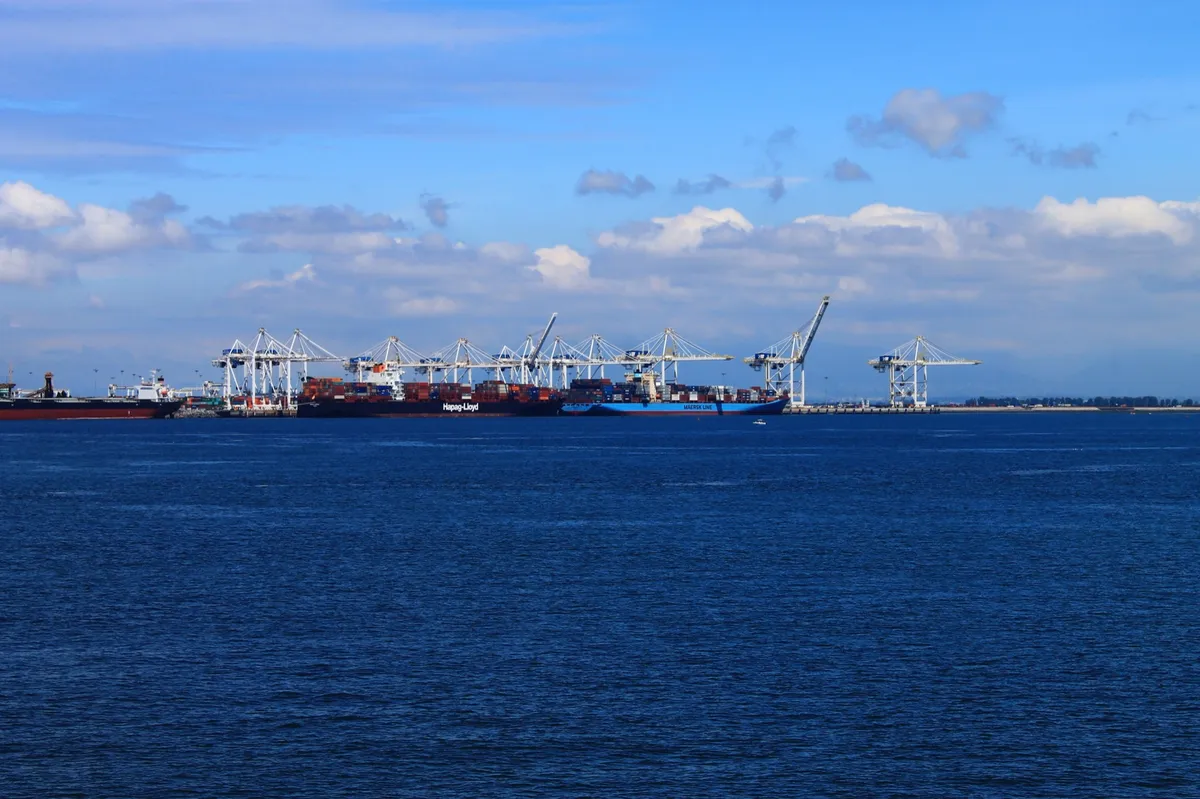
China to Canada shipping time runs from 3 to 5 business days by express courier, 6 to 10 days by air freight, and 15 to 45 days by sea, depending on which port your cargo lands at and how far it still has to travel inland. The mode is only half the answer. A container discharged in Vancouver and delivered in Burnaby is a two-week shipment. The same container delivered in Toronto is a four-week shipment, because 4,400 km of rail sits between the terminal and the warehouse.
This guide gives the 2026 numbers lane by lane, then breaks down where the days actually go. Most importers who ask “how long does it take” are really asking two different questions: when will my goods leave China, and when will I be able to sell them. Both are answered below, with the customs mechanics that decide the second one.
How long does DDP shipping from China to Canada take?
Door-to-door transit times for commercial cargo in late 2026, measured from a cargo-ready factory in South or East China to a delivered address in Canada:
| Mode | British Columbia | Prairies (AB, SK, MB) | Ontario / Quebec | Best for |
|---|---|---|---|---|
| Express courier | 3-5 business days | 4-6 business days | 4-6 business days | 45-100 kg, samples, a line-down emergency |
| Air freight DDP | 6-9 days | 7-10 days | 7-10 days | 100-500 kg, FBA restock, launch stock |
| Sea LCL DDP, consolidated | 18-26 days | 21-30 days | 23-38 days | 1-15 CBM |
| Sea FCL DDP, fast direct string | 15-20 days | 20-25 days | 25-30 days | 15+ CBM, dated delivery needed |
| Sea FCL DDP, standard string | 25-33 days | 28-36 days | 32-45 days | 15+ CBM, date flexibility |
Two things about this table are worth stating plainly, because competitor pages usually leave them out.
The first is that the sea ranges are wide because there are two different products inside them. A fast direct string is a premium service: a carrier with a fixed weekly slot, priority discharge, and pre-booked rail. It costs more per container and it delivers Vancouver in 15-20 days. A standard string is whatever the alliance rotation offers, and in 2026 that has meant longer port stays and slower rail allocation. Both are quoted as “FCL to Canada” and the difference is two weeks.
The second is that LCL is not simply slower than FCL. It is slower at the origin and destination ends, not at sea. Your cartons wait for the next consolidated sailing, then wait again for deconsolidation in Vancouver before the container is stripped. That is why LCL adds 5 to 8 days even when it sails on the same vessel.
Which clock are you reading: door-to-door, port-to-port, or days at sea?
Almost every transit-time dispute comes from two people reading different clocks. Fix the definitions before comparing quotes.
- Days at sea is the vessel’s water leg only, from departure to arrival. It is the smallest number anyone can put in a proposal and the least useful.
- Port-to-port adds origin terminal handling, loading, discharge and terminal release. It matches what a carrier schedule shows.
- Door-to-door adds factory pickup, export declaration, consolidation, Canadian clearance, rail or truck, and the delivery appointment. This is what you can plan inventory around.
A carrier schedule that says Shanghai to Vancouver is 17 to 27 days port-to-port describes the second clock. Add 4 to 6 days for origin work and 5 to 9 days for British Columbia delivery and the same shipment is a 26 to 42 day door-to-door move. Nobody is lying in either case. They are quoting different spans.
Ask a forwarder which milestone starts the clock. If the answer is “sailing date”, the quote quietly excludes the week before loading, which is exactly the week where bookings miss cut-offs.
Why the province matters more than the port
Canada is the second-largest country in the world and almost every Asia shipment arrives on the west coast. The inland leg, not the ocean leg, is what separates a three-week shipment from a six-week one.
| Destination | Main gateway | Port to rail terminal | Rail / truck | Typical door-to-door (FCL) |
|---|---|---|---|---|
| Vancouver, Victoria, Kelowna | Vancouver (CAVAN) | 14-20 days | 1-3 days | 15-20 days premium, 25-33 standard |
| Calgary, Edmonton, Winnipeg | Vancouver or Prince Rupert | 14-20 days | 3-6 days | 20-28 days premium, 28-36 standard |
| Toronto, Hamilton, Ottawa | Vancouver / Prince Rupert | 14-22 days | 5-8 days | 25-32 days premium, 32-44 standard |
| Montreal, Quebec City | Montreal (all-water) or Vancouver + rail | 26-35 days via Panama | 1-3 days | 28-38 days premium, 35-50 standard |
| Halifax, Moncton | Montreal or Halifax | 26-40 days | 2-5 days | 30-42 days premium, 38-52 standard |
The single biggest routing decision for Ontario cargo is whether to use Vancouver or Prince Rupert. Prince Rupert sits about 36 nautical hours closer to Chinese ports than Vancouver, handles less volume, and connects directly to the CN network that runs to Toronto and Montreal. In our own 2026 bookings, Prince Rupert to Toronto has been 3 to 5 days faster than Vancouver to Toronto during congested weeks, even though the vessel arrives later on paper.
The exception is Quebec and Atlantic Canada. An all-water service to Montreal through the Panama Canal looks slow at 26 to 35 days port-to-port, but it skips the entire cross-country rail leg, so door-to-door it often beats a Vancouver routing for Montreal addresses. Relay services to Montreal and Halifax that transship through Europe or North Africa can run past 50 days. Ask which routing the quote assumes before you accept a Montreal date.
How long does sea freight take, port pair by port pair
Ocean transit for the China to Canada lane, 2026 planning ranges:
| Origin port | Destination | Premium direct service | Standard carrier schedule |
|---|---|---|---|
| Shanghai | Vancouver | 11-16 days | 17-27 days |
| Ningbo | Vancouver | 11-17 days | 18-29 days |
| Yantian / Shekou (Shenzhen) | Vancouver | 12-18 days | add 4-8 days to direct |
| Qingdao | Vancouver | 14-20 days | add 4-8 days to direct |
| Shanghai | Prince Rupert | 12-19 days | 16-24 days |
| Ningbo | Montreal (all-water via Panama) | 26-35 days | 29-40 days |
The gap between the two columns is the whole reason fast-boat services exist. A direct string with a fixed weekly departure and priority berth booking compresses the ocean leg by roughly a week and removes most of the waiting at anchor. It is a paid upgrade, and on cargo with a hard delivery date it is usually the cheapest week you can buy.
For cargo that is late but not urgent enough for air freight, the fast string plus Prince Rupert routing is the compromise most of our Ontario customers land on.
How long does air freight take, and when is it actually faster
Air freight from China to Canada is 6 to 10 days door-to-door, with the flight itself taking 1 to 3 days. The rest is pickup, export screening, airline cutoff, clearance at the first Canadian airport, and the domestic leg.
| Route | Service type | Door-to-door |
|---|---|---|
| Shenzhen (SZX) to Vancouver (YVR) | direct or express | 5-7 days |
| Hong Kong (HKG) to Vancouver (YVR) | direct or express | 5-7 days |
| Shanghai (PVG) to Toronto (YYZ) | direct | 7-9 days |
| Guangzhou (CAN) to Montreal (YUL) | connecting | 8-11 days |
Air is faster than sea by three weeks, and it is only worth that premium in specific cases: high value per kg, an FBA listing about to go out of stock, a launch date that cannot move, or a product whose margin absorbs CAD 8 to 12 per kg. For dense, low-value cargo, the air premium usually exceeds the lost margin from waiting.
Two mechanics add days in practice. Airlines close out cargo 6 to 12 hours before departure, so a Thursday afternoon factory pickup does not fly Thursday night. And second-leg domestic capacity in Canada is thin on weekends, which is why a Friday arrival at YVR can sit until Monday.
How long does express courier take
Express is 3 to 5 business days door-to-door, and it is the only mode where the carrier controls every handoff. For a 45-100 kg shipment that must land this week, it is often the right answer even at CAD 9 to 14 per kg, because the alternative is a week of lost sales.
Below that weight, courier accounts exist, but our DDP service does not go under 45 kg. That floor is not bureaucracy: a commercial entry, a Canadian business number, and duty and GST accounting cost the same whether the shipment is 5 kg or 500 kg, and spreading that fixed cost over a parcel produces a rate nobody accepts.
Where the days actually go: a day-by-day breakdown
Here is a 40HQ from Ningbo to a Toronto warehouse, broken into stages with the day ranges we see across 2026 bookings. Total: 30 to 36 days.
| Stage | Day range | What happens | What can stall it |
|---|---|---|---|
| Booking and space confirmation | Day 0-3 | SO issued, container allocated | Peak season space shortage |
| Factory pickup and loading | Day 1-4 | Trucking, loading, VGM weighing | Supplier not actually ready |
| Export declaration and ACI filing | Day 2-5 | China export release, CBSA advance manifest 24 hours before loading | Late or wrong HS code |
| Vessel loading and departure | Day 4-7 | Gate in, cut-off, sail | Missed cut-off, rolled cargo |
| Ocean transit | Day 6-24 | Ningbo to Vancouver | Weather, blank sailings, anchorage waiting |
| Discharge and terminal release | Day 24-27 | Unload, stack, available for pickup | Terminal dwell, rail car shortage |
| CBSA clearance | Day 25-28 | Entry, duty and GST accounting, release | No CARM/RPP set up, exam, valuation query |
| Rail to Toronto | Day 27-33 | CN from Vancouver or Prince Rupert | Rail dwell, winter service disruptions |
| Local delivery | Day 32-36 | Destuff, appointment, unload | Dock booking, FBA appointment slot |
Read the table as a diagnostic tool. If a shipment is late and the ocean leg matches its schedule, the delay is in one of the four rows after discharge, and that is where to ask questions.
What adds days in 2026
Five delay sources account for most of the late shipments we see. Each has a different fix.
CARM and RPP not in place. The CBSA Assessment and Revenue Management system has been the official system of record since October 2024, and the transition measures ended on 31 December 2025. The Section 17 amendments to the Customs Act came into force on 1 January 2026, which means the entity named as importer of record at accounting is liable for the duties, including amounts later found owing on verification. In practice: the importer needs a business number, a CARM Client Portal registration, enrolment in Release Prior to Payment, and posted financial security before cargo arrives. A shipment that lands without this setup can sit at the terminal for days while a broker works around it. This is the single most common cause of an unexplained five-day hold in 2026, and under DDP it is our job, not yours, to have it ready.
A customs exam. CBSA can order a documentary review or a physical examination at the port. A VACIS x-ray is usually 1 to 3 business days. A full destuff and inspection at Vancouver is 3 to 10 business days, plus rework and re-rail. Exams are targeted by risk, not random, and the triggers are predictable: new importers, unusual HS codes for the declared value, brand-heavy cargo without authorization letters, and product categories under trade remedy measures.
Vancouver congestion and rail allocation. Vancouver is the bottleneck in every bad week. Terminal dwell and rail car supply were both strained through 2026, and once a container is discharged the wait for a rail slot can exceed the ocean leg’s variance. Prince Rupert exists as the hedge, and it is underused.
Peak season cut-offs. Chinese New Year 2027 falls in mid-February, which means factory closures from roughly 20 January and a booking crunch from early January. Golden Week in early October removes a week of production and a week of sailings. Q4 e-commerce volume pushes air rates up and space down through November. If you need goods in Canada by a fixed date, book four weeks earlier than the calendar suggests.
Documentation gaps on the Canadian side. A missing commercial invoice line, a packing list that disagrees with the invoice, no Canadian importer business number, an HS code that does not match the product, or a product that needs a compliance mark (electrical goods, toys, children’s products, food contact items) all stop an entry. None of them is a transit problem. All of them cost transit days.
Tariffs and surtaxes are a separate matter from transit time. A surtax changes what you pay at accounting, not how long the ship takes, unless the classification itself is disputed. The 2026 Canada-US dispute and its effect on China-origin goods is covered in our US-Canada trade war analysis.
Three shipments, dated
Ranges are useful; dated examples are how you check whether a promise is real. These three are built from the tables above.
A. 8 CBM of home textiles, Shenzhen to a Vancouver 3PL. Cargo ready 3 November. Next consolidated sailing 8 November. Vancouver arrival 24 November. Clearance and deconsolidation 25 to 26 November. Delivered 28 November. Door-to-door: 25 days.
B. 1x40HQ of furniture, Ningbo to Toronto. Cargo ready 3 November. Cut-off 6 November, sailed 9 November. Vancouver 26 November. CBSA release 27 November. Rail departs 29 November, arrives Toronto 4 December. Destuff and delivery 6 to 8 December. Door-to-door: 33 to 35 days.
C. 320 kg of consumer electronics, Shenzhen to an Amazon fulfillment centre in Calgary. Cargo ready 3 November, flight 5 November, lands YVR 6 November, cleared 7 November, trucked to Calgary 8 to 9 November, FBA appointment 12 November. Door-to-door: 9 days.
Note what example C includes that a quote often does not: the appointment. Amazon does not accept unscheduled freight, and a missed slot means the goods sit in a carrier warehouse accruing storage while a new slot is issued.
Amazon FBA Canada: what the appointment adds
FBA shipments to Canada add two variables that do not exist for a normal warehouse delivery.
The first is the delivery window. Amazon assigns a slot, and the carrier must hit it. If the container arrives in Vancouver earlier than expected, that is not an advantage: early arrival means storage until the slot opens. If it arrives late, the shipment is rescheduled, typically 3 to 10 days out in peak season.
The second is prep and labelling. FBA Canada requires carton labels, pallet labels and, for some categories, poly-bagging and suffocation warnings. Prep done at origin adds 1 to 3 days before sailing and saves far more than that at the receiving centre, where non-compliant cartons are refused.
For FBA, plan backwards from the slot, not forwards from the sailing. A Toronto fulfilment centre slot on 20 December means the container has to sail by roughly 10 November on a standard string.
How to take days off your next shipment
Ranked by days saved per dollar spent:
- Fix the CARM setup before anything ships. Two to five days saved, no freight cost. Registration, business number, RPP enrolment and security are prerequisites, not paperwork to catch up on later.
- Book a fast direct string when the delivery date is fixed. Five to eight days saved versus standard, at a premium that is usually a fraction of the air alternative.
- Route Ontario cargo through Prince Rupert. Three to five days saved in congested weeks.
- Close the documentation three days before cut-off. One to five days saved, depending on what was wrong.
- Ship air for the urgent 20% and sea for the rest. Splitting a launch order is normally cheaper than upgrading all of it.
- Book the FBA appointment before the vessel sails. Three to ten days saved when the slot would otherwise be assigned after arrival.
- Avoid the two weeks around Chinese New Year and Golden Week. Ten days saved, in effect, by not competing for the last slots.
FAQ
Is 15 days from China to Canada realistic? Yes, for a fast direct sailing into Vancouver followed by local delivery in British Columbia. Port-to-port on the best strings runs 11 to 16 days, and Vancouver delivery adds 2 to 4 days. For Toronto or Montreal in 15 days, no: the rail leg alone is 5 to 8 days.
Does DDP make shipping faster or slower? Faster at the border, slower at origin. DDP lets a forwarder pre-file and pre-clear under its own importer setup, which can take 2 to 5 days off Canadian clearance. Consolidating your cargo into a shared container, which most DDP services do below 15 CBM, adds 3 to 6 days before sailing.
What is the fastest way to ship from China to Canada? Express courier, at 3 to 5 business days, if the cargo is under about 100 kg and the margin supports CAD 9 to 14 per kg. Above that, air freight at 6 to 10 days is the practical ceiling.
How long does clearance at CBSA take? One to three business days for a complete entry with pre-arrival filing. Add 3 to 10 days if an examination is ordered, and add several days if the importer’s CARM and RPP setup is missing.
Why is my container sitting in Vancouver? Three usual causes: waiting for a rail slot, waiting on a CBSA exam, or waiting on an incomplete entry. Ask for the release status and the rail billing date, which will identify which of the three it is.
Does the 2026 tariff situation change transit times? Not directly. Surtaxes and anti-dumping duties change the amount payable at accounting. The exception is a classification dispute, where CBSA can hold the goods while the valuation or tariff classification is confirmed.
Can I ship less than 45 kg on DDP? No. Our minimum is 45 kg, roughly 0.3 CBM at e-commerce density. Below that, courier accounts are the only sensible option.
How accurate is a quoted transit time? Treat any date as a planning range with a five-day tail. The parts a forwarder controls are booking, documentation, clearance setup and delivery booking. The parts nobody controls are weather, port congestion, rail allocation and CBSA examination.
Getting a date you can plan around
A transit time is only useful if someone will stand behind the milestone it starts from. We quote China to Canada DDP with a named sailing or flight, a clearance plan that assumes your CARM setup is complete, and a delivery date that accounts for the inland leg rather than stopping at the port. Rates, duties, GST/HST and final delivery are in one number, and the 45 kg minimum is stated up front rather than discovered at booking.
Our Canada DDP route page covers the service scope, and the FCL and LCL guides drill into container economics if you are choosing a mode. If you already know your volume and destination postcode, send the details and we will return a dated plan with the sailing we would book.